Celebrating Greek Independence Day: A Global Tribute to Resilience and Identity


Greek Independence Day falls on March 25 and has been celebrated annually since the end of the Greek Revolution in 1821. It is also known as the Celebration of the Greek Revolution and honors the Greeks’ fight for freedom after being occupied by the Ottoman Empire for over 400 years. This day is also when the Feast of the Annunciation is commemorated.
The Greek Orthodox Church played a crucial role in the Greek War of Independence by preserving Greek national identity and providing spiritual support to the revolutionaries. It helped unite the Greek people against Ottoman rule and was instrumental in fostering a sense of national consciousness during the struggle for independence.
Mani was the place where the Greek uprising against Ottoman rule actually started, and not in Kalavryta on March 25th, 1821, as is often believed. Although that date was later designated as the day of revolt and the beginning of the War of Independence, revolutionary acts took place in several areas across the Peloponnese as early as March 17th of that year.
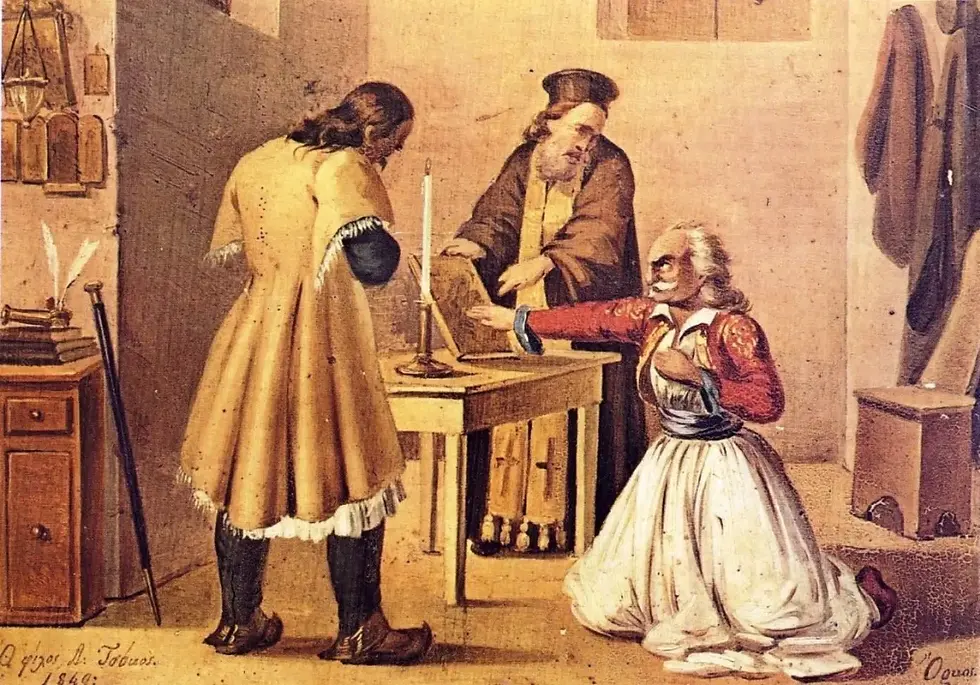
Mani was the first area on the Peloponnesian Peninsula to declare an open revolution, and they did so on March 17, 1821. Their bold declaration was in line with the plans of the secret revolutionary society Filiki Eteria. The Filiki Eteria (Φιλική Εταιρία), or the Society of Friends, as it was otherwise known, was founded on September 14, 1814, and played a crucial role in the uprising which led to the Greek War of Independence against the Ottoman Empire on March 25, 1821. The beginning of the Filiki Eteria: The three founders were Nikolaos Skoufas from the Arta province, Emmanuil Xanthos from Patmos, and Athanasios Tsakalov from Ioannina.
In the beginning of the 19th century, the notion that Greece had to be liberated after almost four centuries of Ottoman rule and that a new Greek state had to be established was ripe. However, there were two camps: those who believed that the time for Greek revolution or war was “here and now” and those who believed that it was too early. In 1814, three Greeks of the diaspora came together in Odessa in present-day Ukraine, where a thriving Greek community lived. They formed a secret society with the purpose of initiating a Greek revolution to rid the country of the Ottomans.
The Greek War of Independence, also known as the Greek Revolution or the Greek Revolution of 1821, was a successful war of independence fought by Greek revolutionaries against the Ottoman Empire from 1821 to 1829. In 1826, the Greeks were assisted by the British Empire, the Kingdom of France, and the Russian Empire, while the Ottomans were aided by their vassals, especially by the Eyalet of Egypt. The war led to the formation of modern Greece,
Greek Independence Day celebration at the Annunciation Greek Orthodox Church in KCMO and St. Dionysios Greek Orthodox Church OPKS March 28th and 29th 2026. https://www.annunciationkc.org/ and https://stdionysios.org/


Comments